 English
Spherical plain bearings are a type of spherical sliding bearing. Their sliding contact surfaces consist of an inner sphere and an outer sphere, allowing for rotation and oscillation at any angle during movement. They are manufactured using various special processes such as surface phosphating, flaring, inlaying, and spraying. Spherical plain bearings have characteristics such as high load capacity, impact resistance, corrosion resistance, wear resistance, self-alignment, and good lubrication.
The structure of a spherical plain bearing is simpler than that of a rolling bearing. It mainly consists of an inner ring with an outer spherical surface and an outer ring with an inner spherical surface. Spherical plain bearings are generally used for low-speed oscillating movements (i.e., angular motion). Due to the spherical shape of the sliding surface, they can also perform tilting movements within a certain angle range (i.e., self-aligning motion). They can still function normally even when there is significant misalignment between the supporting shaft and the housing bore.
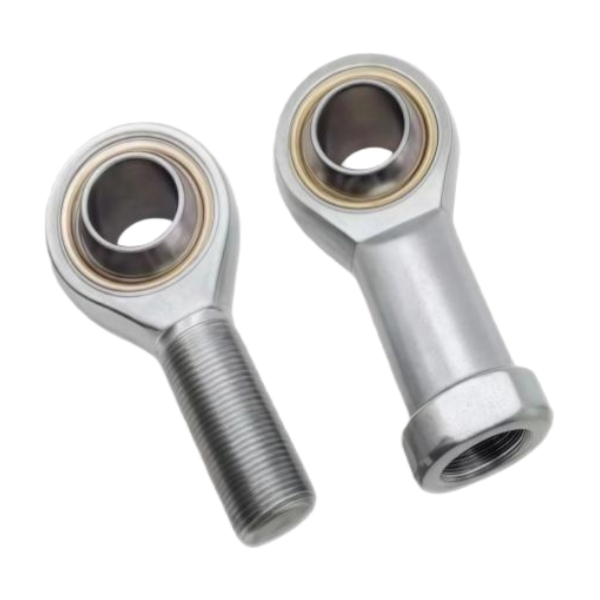
Spherical plain bearings can withstand large loads. Depending on their type and structure, they can withstand radial loads, axial loads, or combined radial and axial loads. Because a composite material is inlaid on the outer spherical surface of the inner ring, the bearing can be self-lubricating during operation. They are generally used for low-speed oscillating movements and low-speed rotation, and can also perform tilting movements within a certain angle range. They can still function normally even when there is significant misalignment between the supporting shaft and the housing bore. Self-lubricating spherical plain bearings are used in industries such as water conservancy and specialized machinery.
Spherical plain bearings can withstand large loads. Depending on their type and structure, they can withstand radial loads, axial loads, or combined radial and axial loads. Because a composite material is inlaid on the outer spherical surface of the inner ring, the bearing can be self-lubricating during operation. They are generally used for low-speed oscillating movements and low-speed rotation, and can also perform tilting movements within a certain angle range. They can still function normally even when there is significant misalignment between the supporting shaft and the housing bore. Spherical plain bearings are widely used in engineering hydraulic cylinders, forging presses, construction machinery, automation equipment, automotive shock absorbers, and hydraulic machinery, among other industries. Introduction and Classification of Spherical Plain Bearings: Spherical plain bearings are spherical sliding bearings. The basic type consists of an inner and outer ring with spherical sliding contact surfaces. Depending on their structure and type, they can withstand radial loads, axial loads, or combined radial and axial loads.
Because spherical plain bearings have a large spherical sliding contact area and a large tilt angle, and because most spherical plain bearings utilize special processing methods such as surface phosphating, galvanizing, chromium plating, or outer sliding surface lining, padding, or spraying, they have a large load capacity and impact resistance. They also possess characteristics such as corrosion resistance, wear resistance, self-alignment, good lubrication or self-lubrication without lubricant contamination. They can even operate normally with misalignment during installation. Therefore, spherical plain bearings are widely used in low-speed oscillating, tilting, and rotating motions.