 English
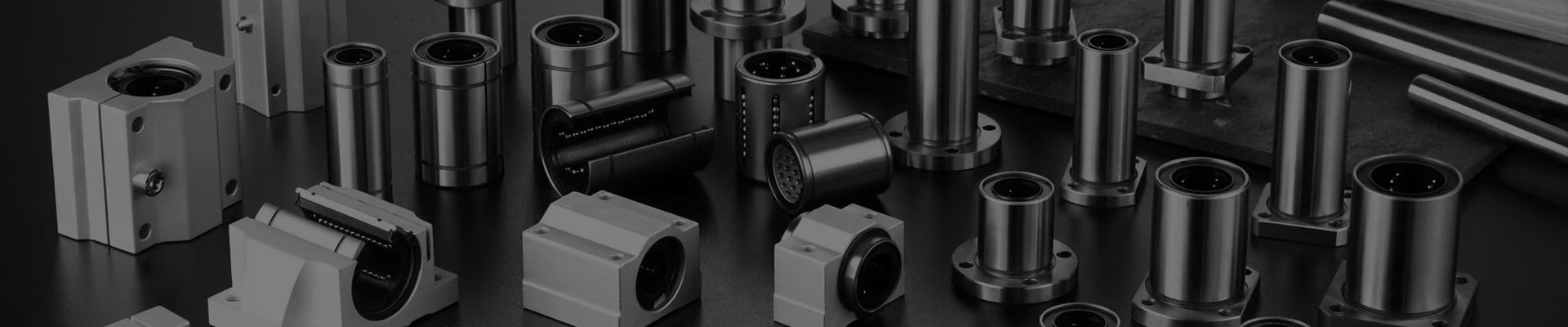
1. Linear Bearings
Linear bearings are mechanical components that support and guide moving parts during linear motion. They are classified into rolling linear bearings and sliding linear bearings based on the force they withstand. Rolling linear bearings are typically supported by rolling elements composed of balls, needles, or cylindrical rollers, while sliding linear bearings use grease lubrication or multi-layer coatings (such as PTFE) for support, possessing self-lubricating properties.
2. Bronze Bushings
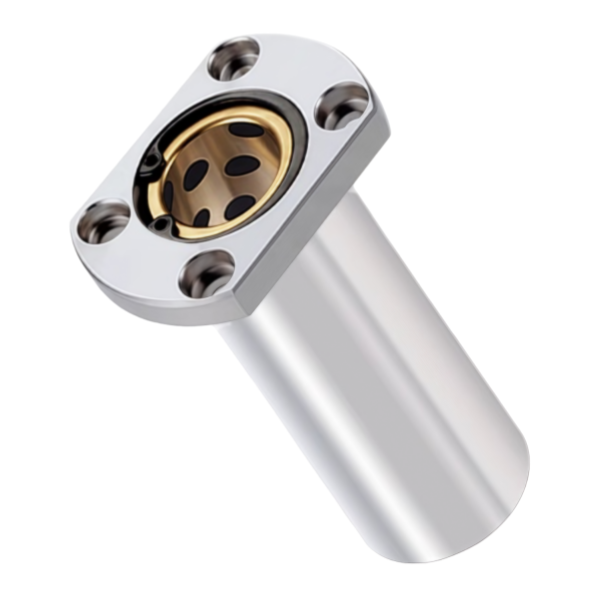
Bronze bushings are mechanical parts that reduce friction between the shaft and the bearing by being fitted onto the shaft or into the inner bore. They are generally made of materials such as copper, aluminum, and steel. Bronze bushings use rolling cylinders or sliding surfaces to support and bear the load of the shaft, and require regular lubrication with grease or other lubricants to reduce friction and wear.
II. Uses and Application Scenarios
1. Linear Bearings
Linear bearings are widely used in industrial machinery, CNC machine tools, automation equipment, power electronic equipment, textile machinery, food packaging equipment, and other fields. Their advantages include low friction, high precision, high speed, good stability, and long service life.
2. Bronze Bushings
Bronze bushings are mainly used in medium-to-low speed heavy-duty equipment such as machine tools, lifting machinery, hydraulic machinery, and light industrial machinery, reducing friction between the rotating or sliding shaft and the bearing through lubrication via oil cups or grease holes.
III. Comparison of Advantages and Disadvantages
1. Linear Bearings
Linear bearings have advantages such as low friction, high precision, high speed, good stability, and long service life. However, achieving balance at high rotational speeds is difficult, and due to limitations in precision and rigidity, they are generally only used in applications requiring high precision.
2. Bronze Bushings
Because bronze bushings use rolling elements or sliding surfaces for support, they have good load-bearing capacity under heavy loads and are also suitable for different friction coefficients. However, they require regular lubrication with oil or grease, resulting in higher maintenance costs.